
LRRPs Step on Landmine - April 1967
Larry R. Thetford LRRP, 3rd Bde 25th Inf div
.....................................................................................................................................................................................
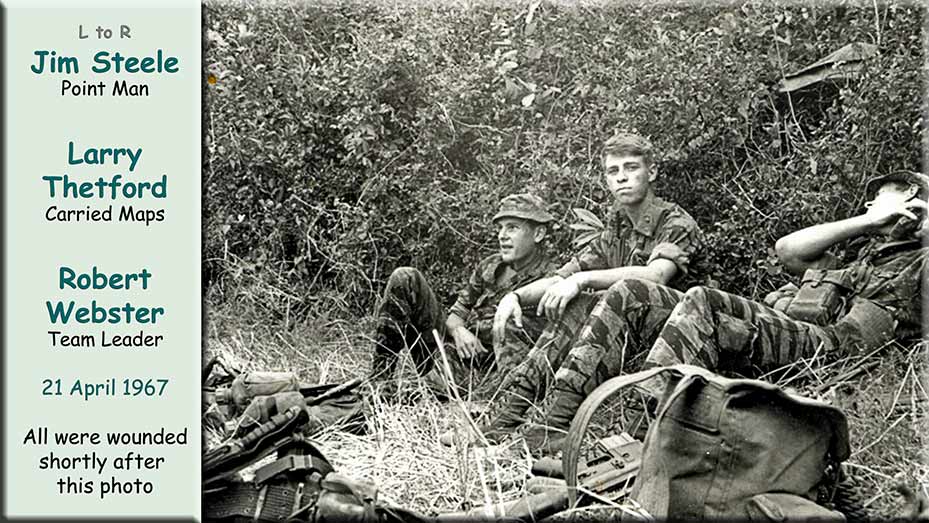 The LZ (Montezuma) was under construction. I found the TOC and reported in. I was directed to my new LRRP team and was pleasantly surprised to learn that my old buddy, Jim Steele, was the point man. We caught up briefly, and I met my new teammates.
Sgt. Robert Webster was the team leader and was one of the most experienced men in the unit. There was no time to get to know each other. My new team was given the first mission in this AO.
Webster gathered the team and told us our mission was to walk off the LZ, down a hill, and hump about five klicks toward the ocean to a group of three mountains. He protested that we shouldn't be walking out into the open, through rice paddies and abandoned villages, in broad daylight, no less, but the battalion commander, Lt. Col. Granger, wouldn’t listen to reason. At 1630, we saddled up and started walking. A couple of hours later, we found a sixty-millimeter mortar emplacement, presumably abandoned by the Marines.
We stopped and took up defensive positions while Webster called in a report on the PRC-25. Steele was on point five yards beyond Webster. The radio man was next to Webster, I was about ten yards from them, and the assistant team leader was five yards behind me when the blast went off. I was hurled into the air and dropped onto my back. Even as the dirt was still raining down, the air was filled with screams. I wriggled out of my pack and crawled forward. The blast had gone off under Sgt. Webster. By the time I got to the radio man, he was crying and touching himself all over. He was covered in blood and blinded by the hot, red liquid covering his face. His left bicep was hanging down into his hand, and I could see his collarbone sticking out through his flesh. The assistant team leader crawled up and ordered the radio man to make contact with battalion.
We then crawled toward Webster, who was sitting up and screaming, “Oh my god, oh my god,” over and over while trying pitifully to put his right leg, which had been severed at the knee, back on. I could not reconcile the juxtaposition of the body parts ripped and torn from Webster’s body. I looked past Webster and saw my best buddy, Jim Steele. He was lying on his face, his side and legs covered in blood. He was not moving. The assistant TL and I began administering first aid to Webster. First, we had to knock him onto his back. My teammate held him down, and I gave him a shot of morphine. We tightened a tourniquet on his leg and applied pressure to the wounds on his arms.
Meanwhile, mortars were falling, being walked closer and closer to our position. I figured the NVA had us pinned there, and it would only be a matter of time before they overran us. With only two of us able to fight, I was resigned to the fact that we would most likely die on this hill. We had been unable to reach battalion. The radio must have been damaged by the blast. All this took place in three to four minutes. What we didn’t know was that, with nothing to do, Delbert Davis, a member of the other LRRP team at LZ Montezuma, had been watching our progress with binoculars. He heard the explosion and saw us strewn across the hill. He alerted the TOC. The mortars were ours, dropped to protect us from being overrun. Choppers were soon in the air, circling but not coming down to pick us up because they weren’t sure if we were in contact. We heard small-arms fire and, though we couldn’t see anything, returned fire. I believe the mortars saved us from being slaughtered. After about twenty minutes of flying around and searching for NVA soldiers, two choppers finally came down to get us. My teammate and I carried Webster to the first chopper. The radio man got on, and by then Steele had regained consciousness and hobbled onto the chopper. They took off, and the assistant team leader and I got on the second chopper and were flown to the brigade aid station. Touching down, I jumped off the Huey and hurried to the tented field hospital.
I watched as a team of doctors and nurses desperately tried to save Webster’s leg. I thought about how just three hours earlier, we had been sitting together on the hill at LZ Montezuma. Webster had talked about going home to Boston. He was short (going home soon) and looking forward to returning to college to finish his education. The more I thought about it, the madder I became. I decided to get a chopper back to Montezuma and have words with Lt. Col. Granger. Just as I turned to act on this rash thought, an aide grabbed my arm and told me to come with him. I was torn, but I went with him. He looked me over and found that I had been hit by shrapnel. He told me to stay put and went to get a doctor. The doctor patched me up and told me I would be medevaced to a hospital. I argued that I didn’t want to go, and he told me it was an order. That was that. A few minutes later, I climbed aboard a chopper and saw Webster and Steele on stretchers, secured to the helicopter's wall. Webster's leg was wrapped in a huge bandage about eighteen inches thick. They were both unconscious. I sat below them on the floor of the dust-off and prayed for my teammates.
We lifted off, and I lit a Chesterfield King as we flew through the evening dusk. I could see the ocean and the fiery red ball of the sun sinking into the Prussian-blue China Sea. It seemed terribly wrong that the sunset was so magnificent. Five and a half cigarettes, smoked back to back, was the length of the trip to the 85th Evacuation Hospital in Qui Nhon.